2025 MET Tower Permit Hearing - Sneaky Trojan Horse
Triple Oak Power and Fred Ruskin Were not Forthcoming about Actual Intent
They stood before the Yavapai County Planning & Zoning Commission on March 20, 2025, and told us these four MET towers were nothing to worry about - just temporary tools for gathering wind data.
They highlighted a letter of support from the Seligman Chamber of Commerce (problematically obtained without full disclosure). They noted they had sent notices to neighbors and received only five responses (mostly simple questions about whether towers would be on their own property) plus two letters of opposition. When commissioners asked what these towers would actually lead to, the response from Triple Oak’s CEO was evasive: it was “too early” to give specific numbers on future turbines. They floated the vague possibility of “multiple hundreds of megawatts” but quickly added that everything would be limited by topography, transmission lines, and environmental constraints.
They minimized the impacts at every turn. The towers would be up for five years at most, then removed. Installation would be quick, operation silent and mostly remote, with almost no ongoing traffic or disruption. Fred Ruskin, the ranch owner, spoke about preserving hunting access and how previous wind efforts on the property had stalled. The whole presentation painted a picture of a small, low-impact, reversible data project on private land.
That was the story they sold in 2025.
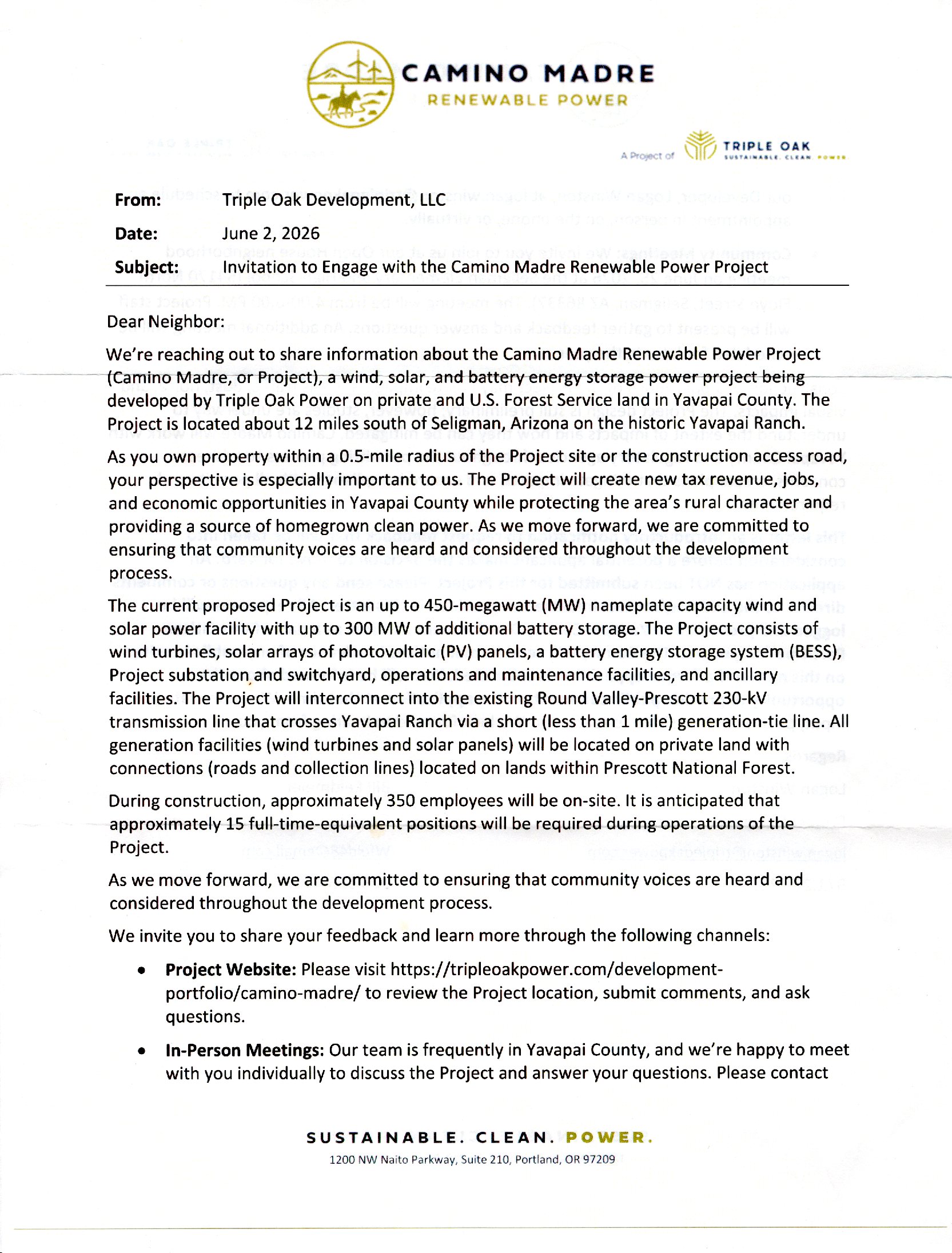
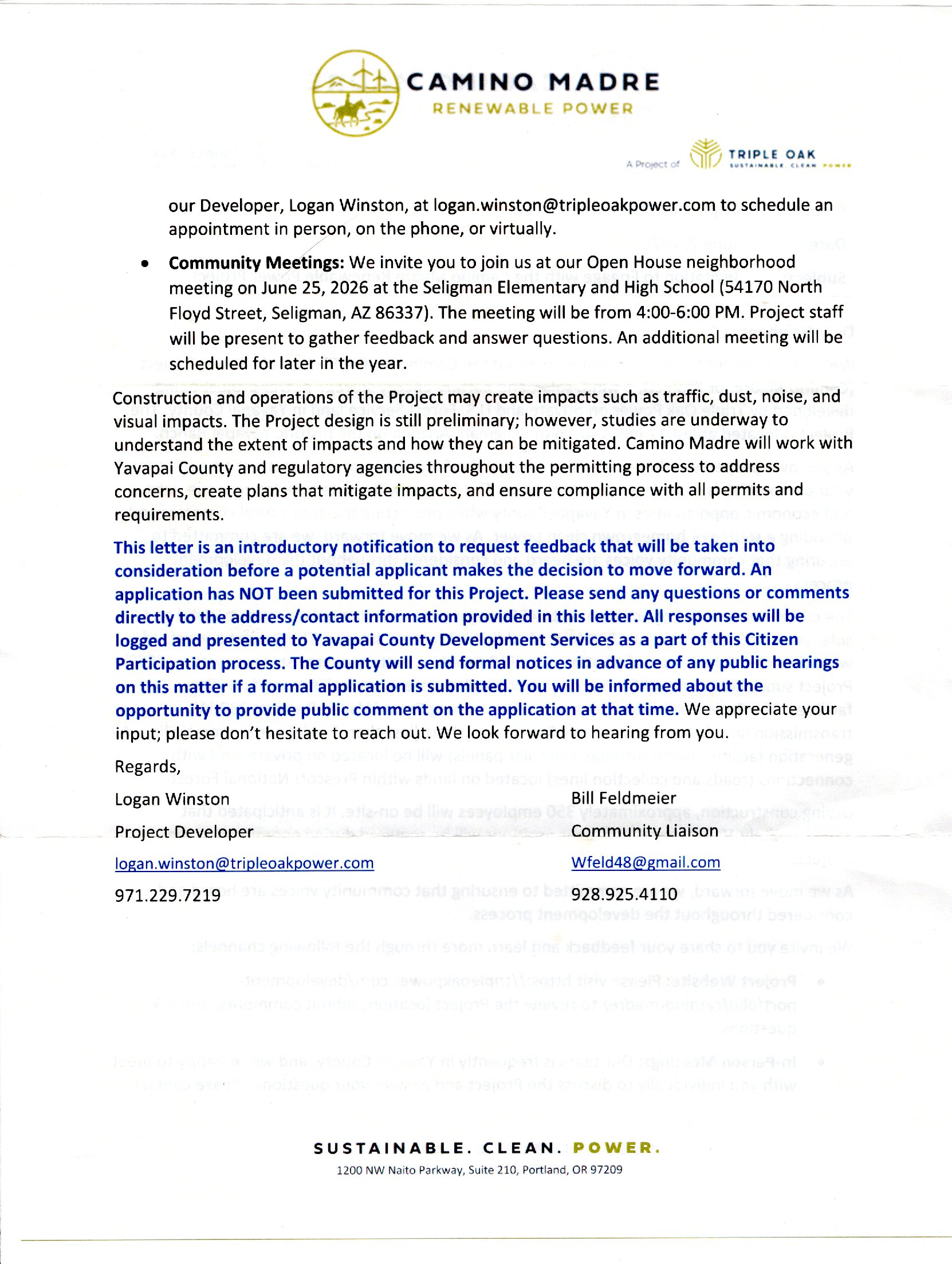
Now read the certified letters they mailed to residents in June 2026 for the full Camino Madre project.
They openly state there will be approximately 350 workers on site during construction - a massive industrial footprint. After completion, they plan for 15 workers to operate the facility. This directly contradicts what they implied in the P&Z hearing, where nearly all operations were described as remote with minimal site visits. They now admit residents will experience equipment traffic, dust, noise, and visual impacts during construction and ongoing operations.
And that’s just the beginning. The current proposal includes not only 76 massive turbines (around 660 feet tall) but also solar arrays and a large lithium battery storage facility on site - turning this historic ranch land into a full-scale industrial renewable energy complex.
This is the contrast that matters.
In 2025 they downplayed it as four temporary poles with almost no footprint.
In 2026 they acknowledge hundreds of workers, heavy equipment, dust, noise, permanent visual changes, solar arrays, and large-scale battery storage.
The test towers were never just about data. They were the first step in a much larger industrial plan they were not ready to fully disclose at the time. The public record shows exactly how the scale and impacts were minimized then - and how they are now being laid out in black and white.We deserve better than this kind of phased reveal. The community has every right to demand full transparency and real consideration of what this project will actually do to our rural landscape, our quiet skies, and our way of life here.
Context from the Meeting
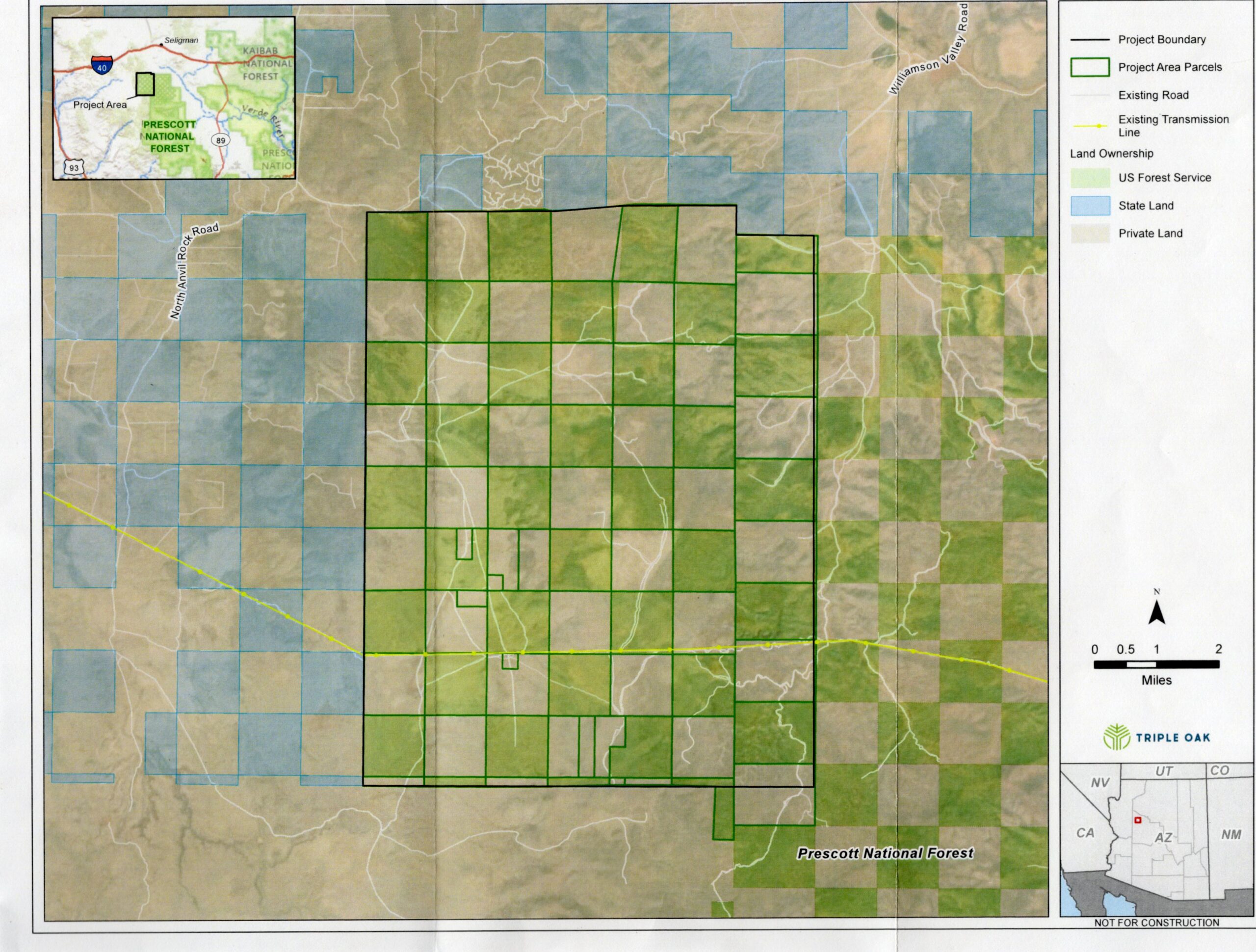
This was the Planning and Zoning hearing on Use Permit PLA24-000120 for four temporary 197-ft MET towers (5-year term) on private Yavapai Ranch land (two large parcels totaling ~11,200 acres) south of Seligman. The purpose was framed strictly as data collection for potential future wind suitability. The Commission recommended approval 8-1 (with one commissioner opposing because it was seen as groundwork for a larger wind farm)
1. Seligman Chamber of Commerce Support Letter (Applicant Statement)
Applicant (Jesse Gronner, CEO of Triple Oak Power): Appreciated “the Seligman Chamber of Commerce’s support for the data collection phase.” They highlighted plans to support local organizations (schools, fire district) and noted community benefits like supplemental landowner income, increased tax base, and improved county roads.
However, sparse support within the town of Seligman was gained without disclosing the real location, size and scope. Most are opposed now that the real plan has been revealed.
2. Neighbor Notifications and Responses (Staff + Applicant)
Staff (Susan Hébert, Planner): Received one letter of support and two letters of opposition.
From the applicant’s citizen participation materials (packet): They sent notification letters in October 2024 (within 1,000 ft) and a follow-up in December 2024 (within ½ mile, ~180 recipients). They received five responses (primarily questions asking if towers would be placed on the recipients’ properties) and two objections:
One general opposition to renewable energy on the property.
One concerned it would “ruin views in the area.”
Applicant clarified that after answering location questions, no further issues were raised. Some returned mail (“return to sender”).
3. Evasive Answers on What MET Towers Would Lead To / Future Project Scale
Applicant (Gronner): When asked directly about the number of future turbines the MET towers might lead to, he “apologized for not being able to answer the specific question.” He stated it was “too early to provide specific numbers of potential wind turbines.”
He described the potential wind farm as capable of reaching “multiple hundreds of megawatts,” but heavily caveated it as limited by topography, wind resources, interconnection capacity (existing lines), and environmental constraints.
Emphasis was repeatedly placed on the MET phase being temporary and data-only — towers would be removed after 5 years (or sooner), with any future wind application requiring separate review and public process.
4. Minimization of Effects / Downplaying Future Impacts
Applicant (Gronner): Stressing the temporary nature — quick installation (about 1 week per site), quick decommissioning, no noise, solar-powered/silent operation, remote satellite monitoring (minimal site visits, monthly data checks), and bi-annual bird/animal carcass searches per AZ Game & Fish guidelines.
Benefits were highlighted (landowner income, taxes, road improvements) while impacts were framed as minimal and reversible.
On wildlife/aircraft: Agreed to add conditions for aircraft warning markers and bird flight diverters.
History context (from Fred Ruskin and applicant): Previous wind interest on/near the ranch had stalled years earlier due to Forest Service access issues, economics, etc. This MET application was presented as a fresh, limited data-gathering step, not a commitment to turbines. Ruskin clarified the project is on private Yavapai Ranch land (checkerboard pattern with Forest), hunting access is preserved, and there was Forest Service support for access negotiations.
Fred Ruskin (Yavapai Ranch owner) Statements
Ruskin spoke to clarify ownership/history: No overlap between Sierra Verde Ranch references and the actual Yavapai Ranch project location. Multiple groups had explored wind in the past (one got furthest ~12 years ago), but it stalled. Recent revival tied to energy demand/shortages.
Emphasized the ranch remains open to hunters and that access/contracts preserve that. “None of the proposed project is taking place on the Sierra Verde Ranch but would be on Yavapai Ranch.”
Noted prior challenges (Forest Service access/communication, gas prices, contract issues) had been addressed.
Video of the Yavapai Planning and Zoning Meeting - March 20, 2025
Letters Sent to Some Residents on or Around December 4, 2025


Certified Letters Sent to Residents on or Around June 1, 2026
One of the MET towers High on a Forested Hill - July 5, 2026
